








Table of Contents
Key Takeaways
- Seated baby walkers with wheels can be risky, as they may lead to falls, burns and other injuries.
- Using a seated walker does not help babies learn to walk faster and may even delay independent walking.
- Push-along walkers are different from seated walkers and are meant for little ones who are already learning to stand and take steps.
- Stationary activity centres and supervised floor play are safer ways to keep babies engaged.
- Before buying, check the product type, recommended age, stability, moving parts, toy safety and usage instructions.
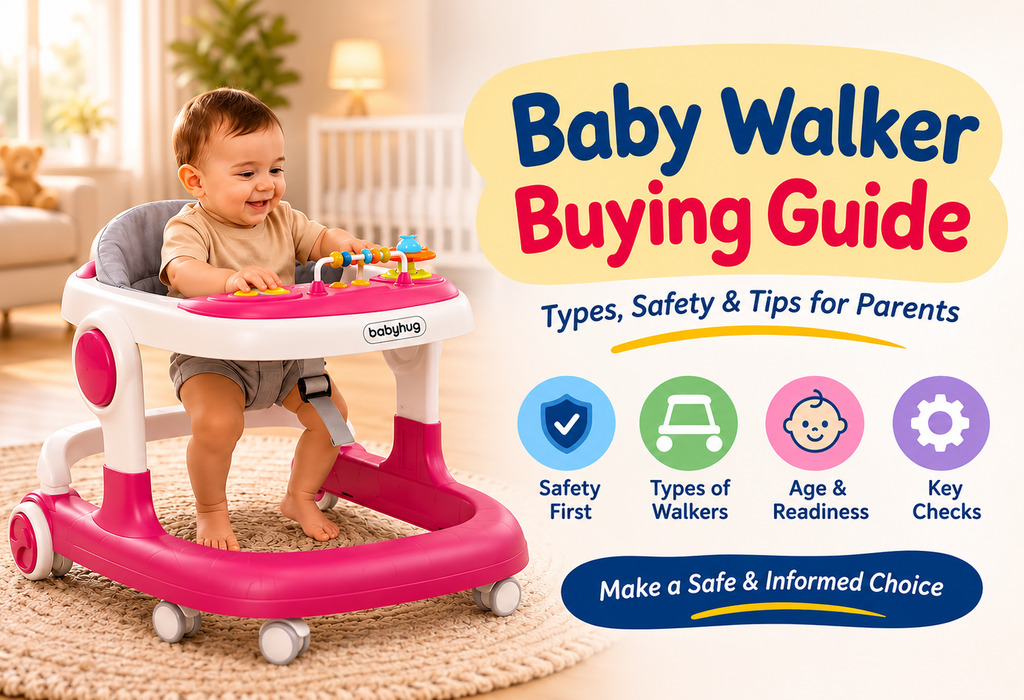
When choosing a baby walker, it is important to understand that seated walkers and push-along walkers are quite different. Seated walkers with wheels are not recommended by child safety experts as they can increase the risk of falls and other injuries. They also do not help babies learn to walk sooner. Whether you are considering a baby walker cycle or another walking toy, understanding the different types and their safety features can help you make a better choice.
What Is a Baby Walker?
A baby walker can mean different things depending on its design. Some have a seat inside a wheeled frame that allows babies to move around using their feet. Others are push-along toys with a handle that little ones push while standing or walking. Stationary activity centres are another option, offering toys and activities without moving around the room.
Types of Baby Walking and Activity Products
You will usually come across three types of baby walking and activity products when shopping. Although their names may sound similar, each has a different design and purpose. Let’s look at how they differ so you can choose the right option.
1. Seated wheeled walker
A seated wheeled walker has a fabric seat fitted inside a frame with wheels, allowing babies to move around by pushing their feet against the floor. However, the American Academy of Pediatrics (AAP) advises against using these walkers as babies can reach dangerous objects, fall and get injured. They also do not help babies learn to walk sooner and may even delay independent walking. [1]
2. Push-along walker
A baby push walker is designed for little ones who are beginning to stand and take steps. It has a handle and a sturdy base that babies can hold on to and push while walking. The Bureau of Indian Standards (BIS) lists these toys under its walk-behind category, with a suggested starting age of 9 months. However, every baby develops at their own pace, so readiness matters more than age alone. [3]
3. Stationary activity centre
A stationary activity centre gives babies a comfortable place to sit and play with attached toys without moving around the room. The Irish Health Service Executive (HSE) considers it a safer alternative to wheeled walkers but recommends using it for short periods with adult supervision.[2]
Baby Walker Safety: What Parents Need to Understand
Safety should always come first when choosing a baby walking product. Seated walkers with wheels allow babies to move quickly and reach things they normally cannot. According to the American Academy of Pediatrics (AAP), these walkers can lead to serious accidents, including falls down stairs, burns, drowning and exposure to harmful substances. Even when parents are watching closely, accidents can happen in seconds. [1]
Why seated wheeled walkers are discouraged
- Falls and head injuries: A walker can travel towards stairs, uneven floor levels or obstacles, leading to a fall or collision.
- Burns and scalds: The raised position can bring a baby within reach of hot drinks, cookware, heaters and other dangerous objects.
- Access to hazards: A baby may reach medicines, cleaning products, cords or objects that would otherwise be out of reach.
- No walking advantage: A seated walker does not teach balance or independent walking. The AAP says use may delay the age at which a child starts walking. [1]
Can supervision make a seated walker safe?
No. Supervision is essential for every baby product, but it cannot prevent every fast movement or sudden fall. The AAP states that most walker injuries happen while adults are watching and says wheeled walkers are never safe to use, even when an adult is nearby. Parents should choose a different play arrangement rather than relying on supervision as the main safety measure. [1]
Are Baby Walkers Recommended for Learning to Walk?
Baby walkers may look like they help little ones take their first steps, but seated walkers with wheels do not actually teach babies to walk. In fact, they may delay independent walking. Babies learn to walk naturally by practising skills such as sitting, crawling, standing and taking steps with support. Giving them enough time and space to practise these movements on the floor is a better way to support their development. [2]
Understanding the Indian Standards Context
You may come across a BIS mark or safety certification when shopping for a baby walker. BIS lists walk-along toys separately under its toy safety standards, but the manual does not specify a separate Indian standard for seated wheeled walkers. So, a general toy safety mark does not necessarily mean that every type of walker is safe or recommended. [3]
The International Organization for Standardization published ISO 23645:2025 covers seated baby walking frames but does not include push-along toys. These are different product categories, so always check the product type and its certification details before buying.[4]
Safer Alternatives to Consider
If you want to give your baby a safe space to play and move around, there are several alternatives to seated wheeled walkers. Here are a few options worth considering.
Stationary activity centre
A baby activity centre gives little ones a place to sit and play with attached toys without moving around the room. Choose a stable design with securely fitted toys and no sharp edges. Keep it away from stairs, heaters and cords. The HSE advises short periods of use under supervision. [2]
Playpen or play yard
A playpen gives your baby a dedicated space to play freely. Make sure the frame locks properly, the mesh is intact and there are no gaps where little fingers or legs could get stuck. Add a few age-appropriate toys and keep the area free of small objects and cords.
Supervised floor play
Sometimes, all your baby needs is a little floor space to practise new movements. Rolling, crawling, sitting and pulling up help babies build their movement skills at their own pace. Provide a clean, firm surface, keep a few toys nearby and stay close while your baby plays.
Push-along walker
A push-along walker can be an option for babies who are ready to stand and take steps with support. Some products, such as the Fab N Funky 2-in-1 Walker, offer both seated and push-along modes. However, these modes should be considered separately. The seated wheeled mode carries the safety risks discussed earlier, while the push-along mode should be checked for stability and ease of movement.
How to Choose a Push-Along Walker or Stationary Activity Product
Before buying a push-along walker or activity centre, take a few minutes to check its design, safety features and instructions. Here are some important things to keep in mind.
- Confirm the product type: Check whether the item is a push-along toy, stationary activity centre or seated wheeled frame. Do not treat the designs as interchangeable.
- Check age and weight guidance: Follow the manufacturer’s stated age and weight limits. For push toys, also consider whether the child can stand and move with support.
- Assess stability: For a push toy, look for a wide, balanced base and a handle fixed securely to the frame. Check whether the toy can tip or roll away too easily.
- Inspect construction and small parts: Look for secure fasteners, smooth edges, no loose components and toys that cannot detach into small choking hazards.
- Read assembly and care instructions: Check that locks engage fully, parts are assembled as directed and removable fabric or toy panels can be cleaned as instructed.
Product Comparison: Which Design Does What?
| Product type | How it works | Buying perspective |
| Seated wheeled walker | Baby sits in a suspended seat and moves the frame with their feet. | Paediatric safety authorities advise against use; choose an alternative. |
| Push-along walker | Child stands behind a solid-base toy and pushes it along. | Check developmental readiness, stability, speed and age guidance. |
| Stationary activity centre | Baby sits and plays with attached toys without travelling around. | A safer alternative to wheeled walkers when used briefly and supervised. |
| Playpen or play yard | Provides a contained floor-play space. | Check locking, structural condition, gaps and safe placement. |
FAQs About Baby Walkers
1. Are seated baby walkers safe for babies?
No. Seated wheeled walkers are discouraged by paediatric safety authorities because babies can fall, reach dangerous objects and move quickly. Close supervision does not remove these risks, so choose a stationary play option instead.
2. At what age can a baby use a push-along walker?
There is no single age that suits every child. Look for signs such as pulling to stand and supported stepping, then check the toy’s stated age and weight limits and follow its instructions.
3. What is the difference between a baby walker and a push walker?
A seated walker carries a baby inside a wheeled frame. A push walker is a solid-base toy that a child pushes from behind while standing. The two products have different uses and safety considerations.
4. Is a stationary activity centre safer than a wheeled walker?
A stationary activity centre is considered a safer alternative because it does not let a baby move rapidly around the room. Use it for short periods, supervise continuously and follow its weight and assembly instructions.
5. What should I check before buying a push-along walker?
Check the age and weight guidance, base stability, handle strength, wheel resistance, secure fasteners and small parts. Choose a design that moves at a pace the child can manage and supervise every use.
6. Does BIS certification mean every baby walker is safe?
No. Check what product category and standard the certification actually covers. A toy-safety mark should not be treated as proof that a seated wheeled walking frame is recommended or risk-free.
7. Are walker-cum-rockers a safer option?
A convertible label does not establish safety. Check each mode separately, follow the instructions and consider whether the seated wheeled mode is involved. A stationary activity centre is a safer alternative to a wheeled seat walker.
Seated wheeled walkers are not recommended by paediatric safety experts because of the risks they pose to babies. Push-along walkers are different and may be considered when a child is ready to stand and take steps with support. Other options, such as baby activity centres, playpens and supervised floor play, can also provide a space for babies to play safely. Before buying, check the product’s age and weight limits, stability, build and safety instructions. If you are unsure which option is right for your baby, speak to your paediatrician.
Sources and References