





Table of Contents
Key Takeaways
- A baby bouncer provides a comfortable, reclined seat for short periods of supervised awake time.
- Check the recommended age range and weight limit before choosing a bouncer.
- Look for an easy-to-use harness, a stable base and a breathable, washable cover.
- Always place the bouncer on the floor and move a sleeping baby to a firm, flat surface.
- Ask the seller about applicable safety standards, as no specific Indian standard for baby bouncer seats was identified.
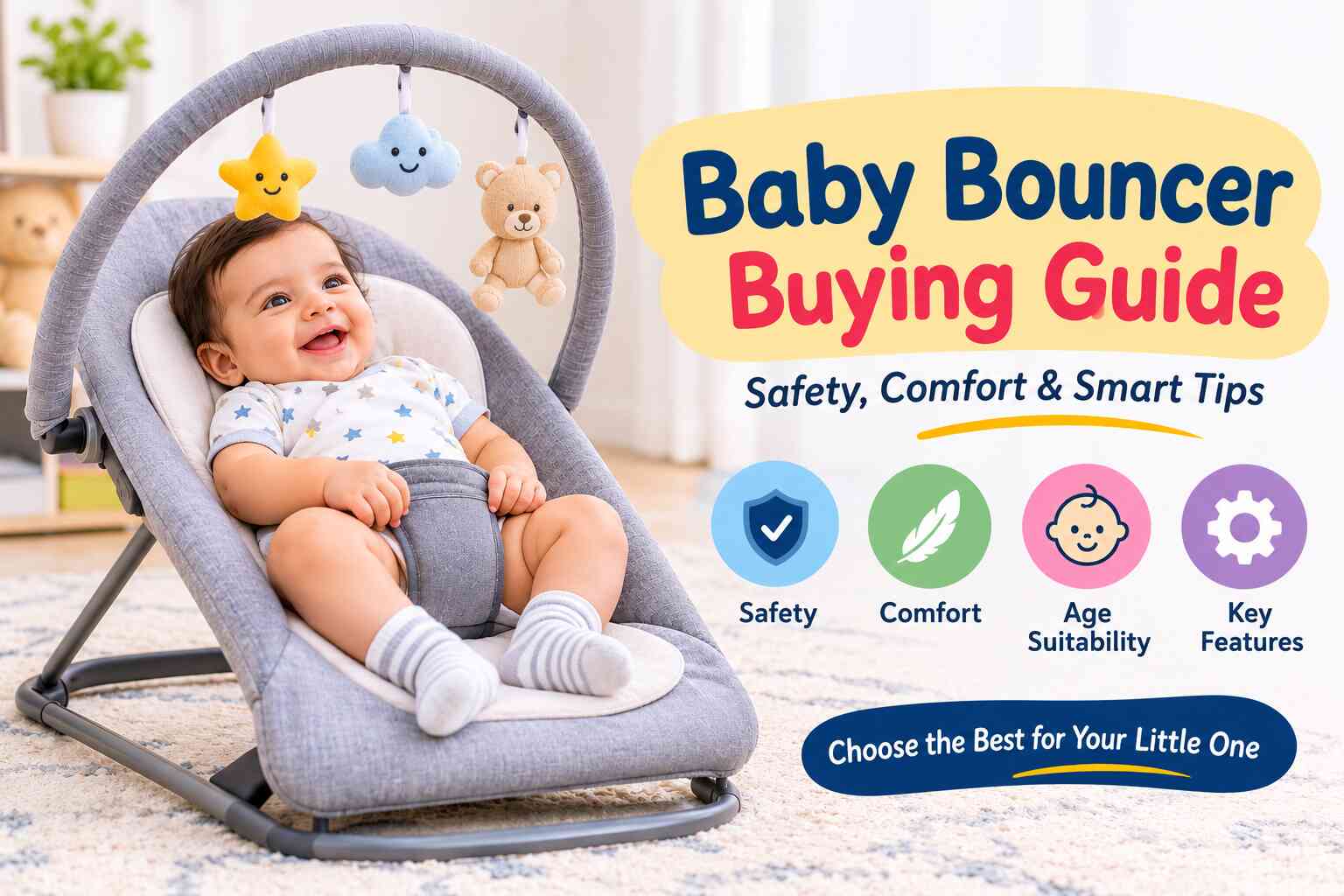
Choosing a baby bouncer starts with thinking about how often and how long your little one will use it. A baby bouncer offers a cosy, reclined seat where babies can spend short periods of supervised awake time before they learn to sit up on their own. You can choose from simple manual bouncers that work without electricity or models with vibration and music features that run on batteries or a plug. Each type has its own benefits, depending on your baby’s needs and your daily routine. This guide walks you through the different types of baby bouncers, their benefits and limitations, important features to look for, safety standards and answers to common questions to help you make the right choice.
| Key Facts
Indian toy rule. BIS requires toys for children of 14 years or younger to carry the ISI mark, so ask the seller whether the toy bar on a bouncer carries one. No Indian standard written for bouncer seats turned up in checks of BIS pages. Sleep guidance. The American Academy of Pediatrics advises avoiding sleep in a seating device such as a swing or car seat, and this international guidance applies to any baby. |
What Is a Baby Bouncer and How Does It Differ From a Rocker or Swing?
A baby bouncer is a free-standing seat that keeps your little one in a comfortable, reclined position. It gently moves when your baby kicks or when you give it a light push. A rocker, however, moves along a curved base, while a swing uses a motor to create a gentle swaying motion. In India, these terms are often used interchangeably in product listings, which can make choosing the right one confusing. So, always read the product description carefully to understand how the seat moves. Door-frame jumpers are different from bouncers and are not covered in this guide.
The table compares four common types by motion, power, floor space and best use, so you can narrow the choice before checking features on a listing.
| Type | How it moves | Power | Floor space | Best suited to |
| Manual bouncer | Moves with the baby’s kicks or a gentle nudge | None | Small, and many fold flat | Short awake play at home |
| Battery vibration bouncer | Adds gentle vibration to the bounce | Batteries or plug | Small to medium | Soothing during fussy awake time |
| Rocker-cum-bouncer | Rocks on a curved base and bounces | None or batteries | Medium | Families who want one seat for several stages |
| Electric swing | Sways on a motor with speed settings | Plug or batteries | Large | Awake soothing at one fixed spot |
Which Type of Baby Bouncer Fits Your Home and Routine?
The best baby bouncer for your home depends on your space, power supply and daily routine. Manual bouncers are a simple choice for smaller homes or places with frequent power cuts. Battery-powered and electric models, on the other hand, offer additional soothing features. Consider what works best for your household before making a choice.
How Does a Vibrating Baby Bouncer Help With Soothing?
A vibrating baby bouncer offers an extra soothing feature that may help some babies settle during fussy moments. Gentle vibrations and soft music can make awake time more comfortable for little ones. However, the type of power supply is worth considering before you buy. Plug-in models need a regular power supply, while battery-operated ones require occasional battery changes. Check that the battery compartment has a secure screw or lock and that the bouncer can still be used comfortably when the vibration feature is switched off.
Does a Foldable Baby Bouncer Suit Small Flats?
A foldable baby bouncer can be a practical choice if you live in a small flat or have limited storage space. It is easy to fold away when not in use, helping you keep your home organised. Before buying, check that the frame locks securely into place and cannot fold while your baby is seated. Also, measure the folded size to make sure it fits comfortably in your available storage space.
What About Rocker-Cum-Bouncer and Swing Combinations?
Rocker-cum-bouncer and swing combinations offer different movement options, making them a versatile choice for parents. However, check the age and weight limits for each seating mode, as the advertised age range may cover the entire product rather than the bouncer stage. If it is described as a cradle or sleeper, follow safe sleep guidelines.
How Can a Baby Bouncer Help Parents?
A baby bouncer can give parents short hands-free moments and give the baby a supported place to watch the room.
- Hands-free moments: The harness holds the baby in the seat, so you can eat a meal or finish a call with your baby in view.
- Gentle motion: Bouncing or vibration may help some babies settle during awake fussy periods.
- Play value: A bouncer with toy bar gives the baby something to look at, reach for and bat.
- Easy to move: Light frames travel from room to room, so the baby can stay near the family.
When Can Babies Start and Stop Using a Bouncer?
A baby can use a bouncer from the age and weight the listing states until the baby can sit up unaided, which the US standard ASTM F2167 describes as roughly 0 to 6 months. That standard is an international reference and not an Indian rule. Check the weight limit against your baby’s current weight, not only the age band, because babies of the same age differ in size.
Is a Baby Bouncer for Newborn Babies Suitable?
Some baby bouncers are designed for newborns, but not every model is suitable from birth. Before buying, check the recommended starting age and minimum weight limit. Look for a seat with a suitable recline and good head support to keep your little one comfortable. If your baby was born prematurely or has a low birth weight, consult your paediatrician before use.
How Do You Choose the Right Baby Bouncer?
The right baby bouncer has a secure harness, a firm grip on your floor, a breathable washable cover and clear age and weight limits. Here are five important things to check before making a purchase:
1. Choose a Harness That Is Easy to Fasten
Look for a secure 2-point, 3-point or 5-point harness with an easy-to-use buckle. Make sure it stays firmly locked and is simple for all caregivers to fasten.
2. Check the Recline and Head Support
Choose a bouncer with adjustable recline positions and proper head support. Avoid seats that make your baby slump forward or lean to one side.
3. Look for a Stable Base
Choose a bouncer with rubber feet or anti-slip pads to prevent it from sliding on smooth tile or marble floors when your baby kicks.
4. Choose a Breathable, Washable Cover
A mesh or cotton-blend cover helps keep your baby comfortable. A removable, washable cover also makes cleaning easier.
5. Check the Toy Bar and Sound Features
Make sure the toy bar attaches securely and can be moved aside when needed. If the bouncer plays music, look for volume control and an off switch.
When Does a Baby Bouncer With Mosquito Net Make Sense?
A baby bouncer with a mosquito net can be useful during mosquito-prone months, especially if you want to keep your little one protected while they are awake. Make sure the net fits securely, stays away from your baby’s face and is easy to remove for washing. Also, check whether the net comes with the bouncer or needs to be purchased separately.
Before buying a baby bouncer, it is important to understand which safety standards apply. No specific Indian safety standard for baby bouncer seats was identified during checks of BIS and consumer-affairs pages, so parents should pay close attention to the safety information provided by manufacturers.
The BIS toy rule mentioned earlier applies to toys attached to a bouncer. Some manufacturers also test their products against international standards such as ASTM F2167 (US), which covers features such as harness safety, stability, slip resistance, frame strength, drop testing, toy bar attachments and battery compartments. The US regulator refers to ASTM F2167-22 for seats manufactured after 19 December 2022.
If a product listing mentions ASTM F2167, ask the seller for the test report and the specific standard edition. Similarly, if you see a BIS or ISI logo, check the licence number rather than relying on the logo alone.
What Are the Limitations and Safety Considerations?
A baby bouncer is meant for short periods of supervised awake time, not for sleeping. Following a few simple safety precautions can help parents use the seat more responsibly.
1. Why Should You Never Let Your Baby Sleep in a Bouncer?
If your baby falls asleep in a bouncer, move them to a firm, flat cot or bed. Since a bouncer keeps your baby in an inclined position, it is not a safe alternative to a proper sleeping surface. Even if a product is marketed as a cradle or sleeper, it should not be used for routine sleep.
2. What Safety Precautions Should You Follow?
- Floor only: Place the bouncer on the floor, never on a bed, sofa, table or kitchen counter.
- Harness every time: Fasten the harness for every session, including short ones.
- Short sessions: Keep sessions short and follow them with floor play and tummy time, so the baby moves freely.
- Constant supervision: Stay within sight and reach, and stop using the seat when your baby can sit up unaided.
3. What Should You Check Before Using a Second-Hand Baby Bouncer?
A second-hand bouncer can be an option if it is in good condition and has all its original parts. Before using one, check the harness for fraying, the frame for cracks, the battery compartment for corrosion and the toy bar for loose fittings. Also, look for product recall notices on the manufacturer’s website or through Consumer Affairs. Avoid using a bouncer if its instructions, age label or weight limit are missing.
How Should You Buy a Baby Bouncer Online or In Store?
Whether you shop online or visit a store, take some time to compare different baby bouncers before making a decision. Check the age and weight limits, harness, seat material, warranty and return policy. If possible, try the seat in person to see how easy it is to use.
1. Pre-Purchase Checklist
- The age band and weight limit match your baby’s current size.
- The harness type is stated and easy to fasten.
- The base has rubber feet or anti-slip pads.
- The cover is breathable and removable.
- The power type, battery or plug, suits your household.
- The warranty, return window and spare-part support are clear.
2. Common Buying Mistakes
- Judging by age band alone: The weight limit decides when a seat stops fitting.
- Trusting a long age band: A listing that runs to two or three years describes the whole rocker or chair, and the bouncer stage is much shorter.
- Trusting a logo: A BIS or ISI logo needs a licence number or standard behind it.
- Skipping the return policy: Check the return window before the box is opened.
Frequently Asked Questions
1. What is the difference between a baby bouncer and a rocker?
A baby bouncer moves with the baby’s own kicks or a gentle nudge, while a rocker moves on a curved base. Indian listings often blend the names, so read the description for the motion and the age band.
2. At what age can a baby start using a bouncer?
A baby can start using a bouncer from the age and minimum weight stated on the listing, which begins at birth for some seats and later for others. Check the minimum weight, and ask your paediatrician if unsure.
3. Can a baby sleep in a bouncer?
A baby should not sleep in a bouncer, because the American Academy of Pediatrics advises avoiding sleep in seating devices. If your baby dozes off, move the baby to a firm, flat cot or bed.
4. How long can a baby stay in a bouncer?
A baby should stay in a bouncer for short, supervised sessions only, and the maker’s manual sets the guidance for each seat. Take your baby out when the baby seems tired or fussy, then switch to floor play.
5. Is a harness necessary in a baby bouncer?
A harness is necessary in a baby bouncer, because it keeps the baby secure in the reclined seat. Look for a 3-point or 5-point harness with a buckle that every caregiver can fasten correctly.
6. How do I protect my baby from mosquitoes in a bouncer?
Choose a seat that includes a net or lets you add one that fits snugly, and keep the net clear of the baby’s face. Use the seat in a screened room, and confirm that the net washes easily.
7. Which baby bouncer brand is best?
No single brand suits every baby. Compare the age band, weight limit, harness type, base grip, cover material and battery needs first, then check whether the listing names a safety standard such as ASTM F2167 and states warranty terms clearly. Choose the brand that meets those checks.
8. Where should I buy a baby bouncer, and what should I check on return and warranty?
Buy from a seller that shows its name and address, states the age band and weight limit, and names the safety standard the seat was tested to. Check the return window, the warranty length and whether spare parts such as harness straps are available.
A manual bouncer, a battery model and a rocker-cum-bouncer suit different households, so match the type to your power supply, space and routine. The key safety rule is to use the seat on the floor for short, supervised awake time. Before buying, check the age band, the weight limit, the harness, the base grip and the named standard. Each baby outgrows the seat at a different pace. Ask your paediatrician if you are unsure which option suits your baby.
Sources and References